

◄ by Erin Rivers – Mission, KS ►
When I hear the history of the world, from the perspective of Chris Jorgensen, it has always made such sense to me, much more sense than the Bible or even the theory of evolution. While I don’t quite understand why it makes more sense, I trust that in the fullness of time, it will. I read quite a bit. For the longest time I have been telling my Attunement friends how much Attunement is written about in literature. Maybe it isn’t written about directly, but so much of what I have read seems to reflect our conversations in any Attunement gathering. One example is Madeline L’Engle’s book, Many Waters. You might recognize this author from The Wrinkle in Time. I enjoy her perspective and her writing and when I picked this book up, it seemed to me to echo what I had heard in my Practitioner’s course on The Fall.
I then began to wonder…does the subconscious of those who are creative (which takes a special kind of energy pattern) pick up on how the Spirit is moving? Does our art follow the pattern of mankind’s coming “up” from The Fall? I noticed that whenever there is a new idea, it seems to hit the planet in a few places at once – and I knew that art represents our highest self, as inadequate as that may seem. Without Beauty, without art, there is no civilization. Without Attunement, in whatever form it is practiced, there is no union with the I AM. Would art be a place that reflects our progress?
In a recent Attunement Group I presented these ideas. I focused only on Western Civilization’s literature and art– though there is much beauty and richness in the literature and art of the many other cultures on our planet. I realize that this is just a broad, general sweep.
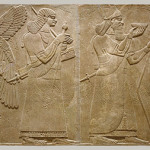
I noted that in the physical expression of mankind after The Fall, that literature was non-existent (as far as we know) the stories being portrayed through oral tradition or through hieroglyphics. The art was one dimensional and often told stories as well.
 |
 |
| Cave painting in Lascaux, France Stone –age (30,000 BCE – 2500 BCE) |
Relief: king and eunuch attendants Mesopotamian (3500 BCE – 539 BCE) |
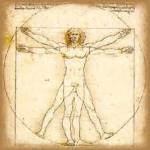
As mankind worked through these vibrations and began to refine toward the mental vibration, literature began to be recorded and the oral traditions copied and preserved. The earliest known literature in the Western Civilization is Beowulf, which tells the tale of Man (in the form of the epic hero Beowulf) battling evil, Grendel, (and his mother – quite a bit of symbolism there) in order to save civilization. Beowulf wins because he uses his mind to meet the monster. Beowulf stands in integrity and agrees to meet Grendel in hand-to-hand combat, not relying on his weapon as the monster has none, and wins because his intellect takes over and he takes advantage of the tools at hand. The literature is beginning to reflect the Mental Expression coming into awareness. The art of the time also begins to show this new vibration, going from one dimensional to experimenting with three dimensions, to realizing in the Renaissance a type of realism that echoes the Enlightenment of the time. The literature reflected this as works began to appear that reflected mankind’s refinement. There is Geoffrey Chaucer’s Canterbury Tales (1390’s), Edmund Spencer’s Faerie Queen (1590), William Shakespeare and John Milton’s Paradise Lost (1667). Each era of literature, echoed in art, reflected mankind’s vibration moving toward a more Spiritual Expression.
 |
 |
 |
||
|
||||
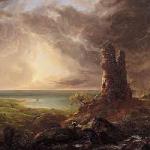
As the spirit vibration began to emerge, there is, in my opinion, a corresponding reflection in both literature and art. In literature, English and American, the Romantics begin to dominate. There is Charles Dickins, the Bronte’ sister, the great poets Tennyson, Byron and Browning – on the English side and, Emerson, Thoreau, Melville, Dickinson and Whitman on the American. Romanticists sought the ideal in man as they struggled with the effects of Industrialization, overcrowding of cities, and the change of culture that went with these changes. They looked to find God or serenity from within and valued intuition, nature, and imagination. This Enlightenment began bringing forth social service and a new type social consciousness that fostered an institutional approach to taking care of the downtrodden. The art of the time reflected this “going inward” and the Romanticism era often shows wide open landscapes highlighting the incredible beauty of God’s nature and man’s miniscule place in it all. Impressionism is next, punctuated by soft colors, blended lines, and obscured figures.
 |
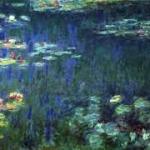 |
| Romanticism (1780-1850) | Impressionism (1865 – 1885) |
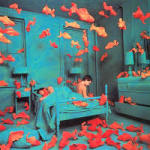
Then, as the vibration began to ascend toward purity, we find that old parameters no longer apply. New concepts began to come into being and old ways, though always challenged, were challenged in a new way. The literature, reflecting two World Wars and much social upheaval, began to move away from reflecting inward and began by questioning social constructs. We see this in works such as Animal Farm, and The Sound and the Fury and with poets such as T.S. Eliot and Allen Ginsburg. More and more the literature began to focus on the individual and the struggles of the individual. It was understood that the individual struggles might be reflected by society in general, but people understood that at the end of it all, the individual was the one who would be called upon to answer for their choices, their journey. Individualism and seeking strength from within began to be the dominant theme with these postmodern writers. In art, Cubism gave way to Surrealism which then moved into Postmodernism.
 |
 |
 |
|||
|
|||||
While this is a broad and sweeping generalization of literature and art through our recorded history, it resonated with me that it correlated pretty well to the vibrational shifts of our world history. I offer another perspective into the myriad ways into which the Radiance of Love shines, even to those who are, perhaps, unconscious of their part in the vibrational shift.
This is very rich, Erin. To see the face of Spirit in all things is a wonderful gift and perspective. Even though there may be forces of resistance and rejection to the “forces from Source”, as Uranda described them, that date back to what has been termed The Fall, the Spirit of God erupts its magic and majesty everywhere. Thank you for your eyes and ears that bear witness to this in the fields of language and art. It was a joy to travel with you through this article!
Very well done Erin. I so enjoyed it when you presented these thoughts in person and again now reading your article. Thank you for your perspective.
You are definitely on to something worthwhile here – lovely and valuable work, to trace and perceive the movement of the Creative Cycles as evident in the Arts from the Fall to these days of greater regeneration and Restoration of the consciousness of man and woman to the consciousness of God. Though the record over the ages has been thin, as substance has been thin, the evidence of the patterns are present and perceivable in literature and art and music, and in many other ways, for those with eyes to see and ears to hear and hearts to understand. All part of the One Great Story unfolding, calling these various aspects of timeless spiritual expression to memory, and thereby clearing away certain subconscious resistances, and cleansing and opening the heart to welcome what is ever-new from the undimensional and invisible realms of Spirit into the greater measure of spiritual substance available in individual and collective consciousness now. These are the days of the union of the subconscious and the conscious aspects of the One Body of God incarnate. In your own way Erin, you have begun to unveil the mystery, tugged gently at the Sacred Thread, and revealed the patterns of a new weaving on earth, as it is in heaven. This is healing, and it is an art in itself – a healing art. Thank you so much. db